

Café · Queens · ⭐ 9.5/10 · 510 reviews · updated: 2026-08-10 16:27:16
Address: 68-04 Burns St, Forest Hills, NY 11375, United States
Three people who already lived in Forest Hills wanted a café they could study and work in, could not find one they liked, and opened it themselves in the autumn of 2022 — not on the neighborhood’s shopping strip but on a quiet residential block between a laundromat and a school. Forest Cafe should by rights have stayed a local secret. Instead people started crossing borough lines for the drinks, and the weekend line out the door is now part of the furniture.
Highlights
- A family business, not a concept. It is run by sisters Julie and Nina Fung together with Nina’s fiancé Paul Shim, an Asian-American family who had already been Forest Hills residents for about a decade when they opened.
- The matcha is whisked by hand, one drink at a time. Nothing is batched in advance, which is why the line moves the way it does and why regulars rate the matcha above almost anything Manhattan puts in front of them.
- A drinks list that reads like a map of Queens. Ube, hojicha, pandan, horchata and earl grey all appear on the same board — a pan-Asian and cross-diaspora vocabulary that would look eccentric almost anywhere else and looks completely natural here.
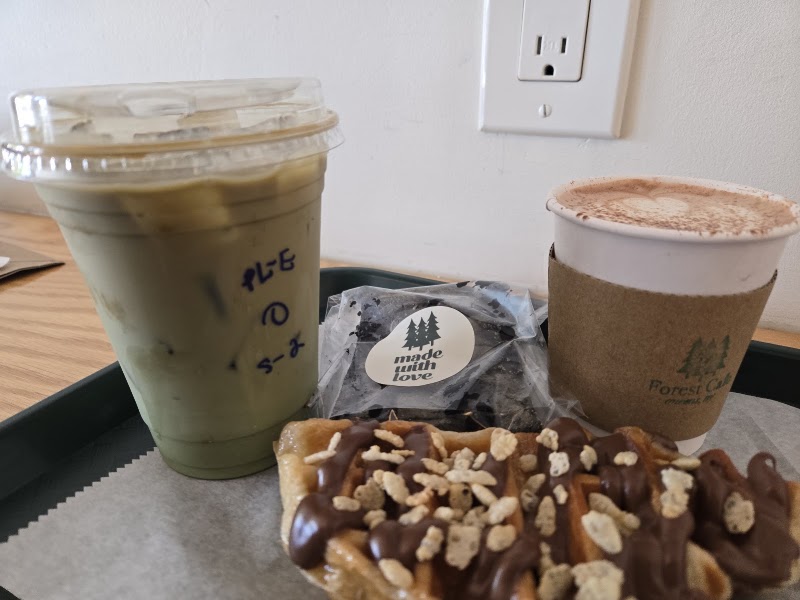
- Croffles made fresh every day. The croissant-waffle hybrid that took over Korean café culture is a house staple here, run through a short rotation of flavors.
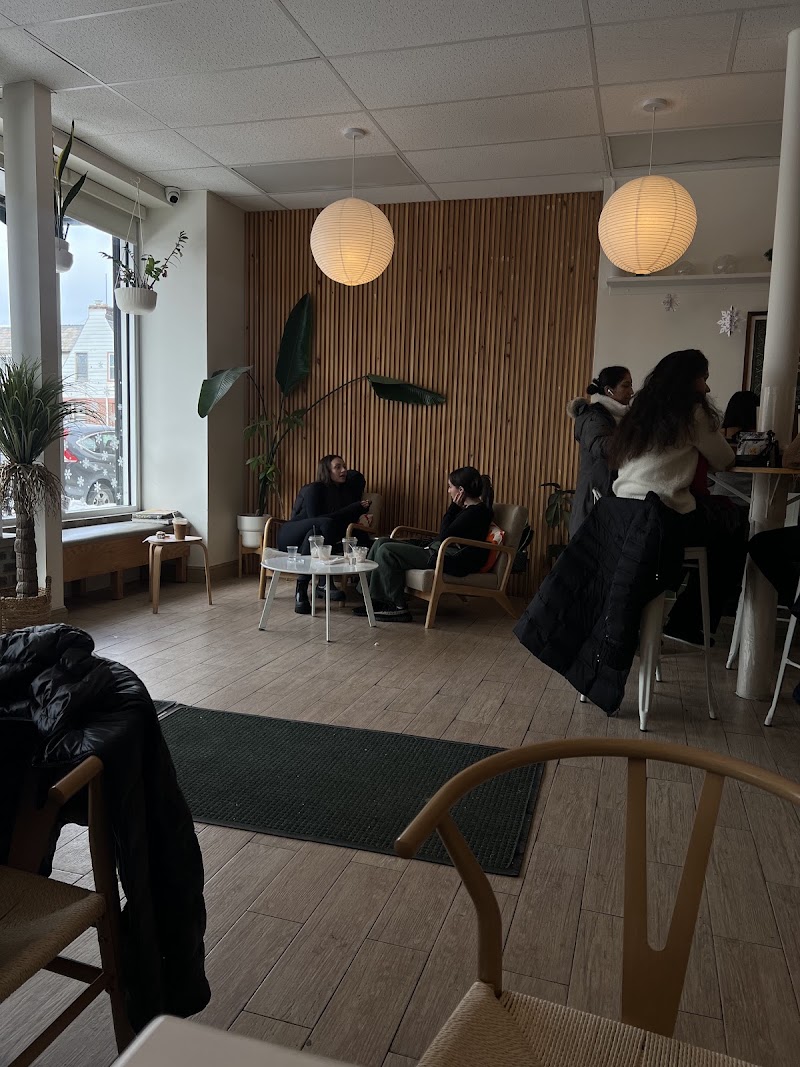
- Designed for laptops from day one. The founders’ stated reason for opening was wanting somewhere to study, and the room is built accordingly: booths, stools, window benches, cushioned chairs, free Wi-Fi, outlets.
- A secret menu. Beyond the seasonal specials there is an off-board list that regulars know about and first-timers have to ask for.
What’s in the cup
The espresso comes from Project X Coffee — Brazilian-grown beans, roasted in Chicago, with a house style consciously shaped by Japanese coffee culture. That last detail matters more than it sounds. Japanese-influenced roasting tends toward clarity and restraint rather than the heavy chocolate-and-caramel profile that dominates American neighborhood cafés, and it explains why the milk drinks here taste cleaner and less sweet than the local average even before you get to what has been added to them.
What has been added to them is the real story. This is a flavored-latte café that manages not to be a syrup café: the ube latte, the hojicha latte, the brown butter banana latte and the house Forest latte are built as drinks rather than as desserts in a cup, and the sweetness generally sits under rather than over the coffee. The iced shakerato — espresso shaken with ice until it foams — is the order for anyone who wants the beans without milk in the summer. Homemade iced tea covers the rest of the table.
The matcha deserves its own paragraph because of how it is made. Most high-volume cafés whisk a batch in the morning and pour from it all day; Forest Cafe does not, and hand-whisks each cup to order. It is a genuinely demanding decision in labor terms, it is the main reason for the queue, and it is why the matcha and hojicha here have a following that extends well past Forest Hills. If you have only ever had batched matcha, this is a useful place to learn what the difference tastes like. The horchata matcha with lavender syrup is the crossover order that best captures what this café is actually doing.
Who’s behind it
Julie Fung, her sister Nina and Nina’s fiancé Paul Shim opened the café in October 2022. All three had been living in Forest Hills for roughly ten years, and the founding motive was almost comically simple: they wanted a cozy place in their own neighborhood where they could sit and study and work, could not find one, and built it. Julie has said she would not mind staying in Forest Hills for the rest of her life, and has talked about wanting the café to become as much of a local landmark as the stadium.
That origin is legible in every decision the business has made. A café opened by people who wanted somewhere to work is a café with outlets and comfortable seats. A café opened by an Asian-American family that grew up in Queens is a café where ube, pandan and hojicha are not exotic guest appearances but the default vocabulary. And a café opened by residents rather than operators is a café that took a residential block instead of paying for a spot on the shopping strip.
What it’s for
Working and studying, above all. This is the scenario the founders explicitly built for, and the room delivers: free Wi-Fi, charging outlets, several kinds of seating so you can pick between a booth for spreading out and a window bench for a laptop and nothing else, and enough natural light that you are not squinting at a screen by mid-afternoon. Nobody moves you along. Students from the surrounding schools and remote workers make up a large share of the weekday room.
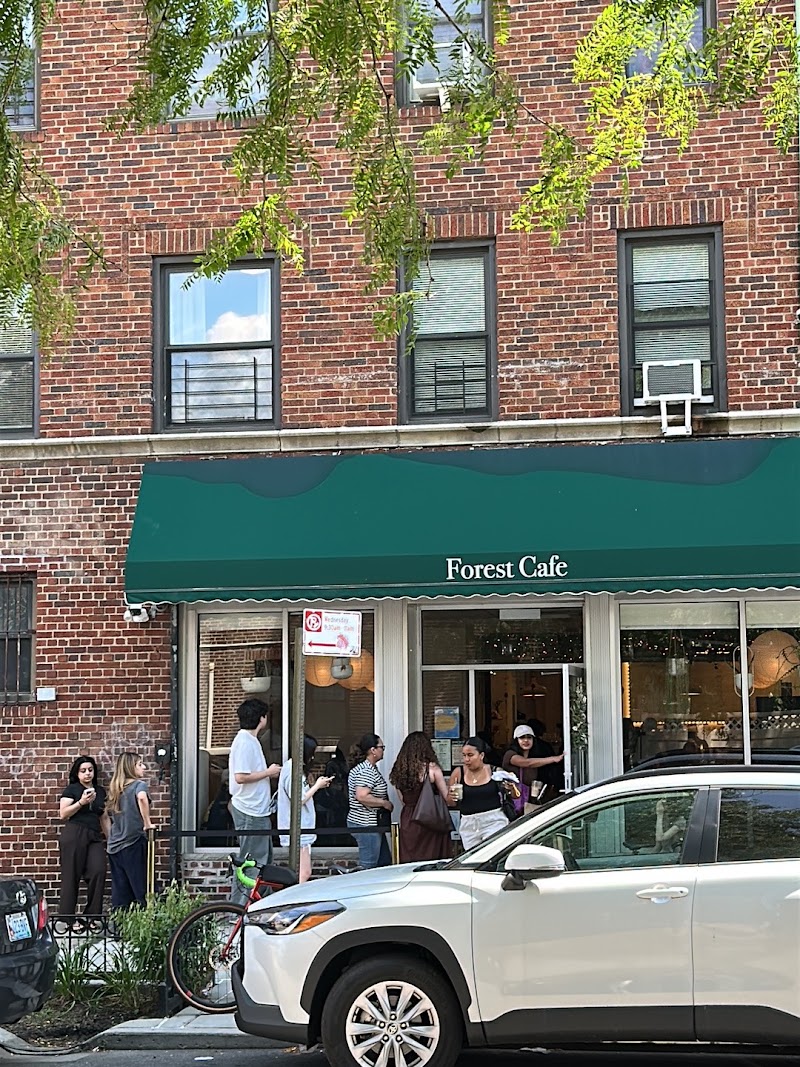
The second scenario is the deliberate visit. A meaningful proportion of the weekend crowd does not live in Forest Hills and did not stumble in — they came for a specific drink, often after seeing it somewhere online, and they are willing to stand in line for it. That changes the character of the room completely between a Tuesday afternoon and a Saturday midday, and it is worth choosing your visit accordingly.
The third is the ordinary neighborhood one: meeting a friend, a slow catch-up over a pastry, a walk that ends with a drink to carry away. Because the café sits on a residential block rather than a commercial one, it functions as a genuine neighborhood living room during quiet hours in a way that shopping-strip cafés rarely do. What it is not built for is the evening — the café closes in the afternoon and there is no dinner or late trade.
The space
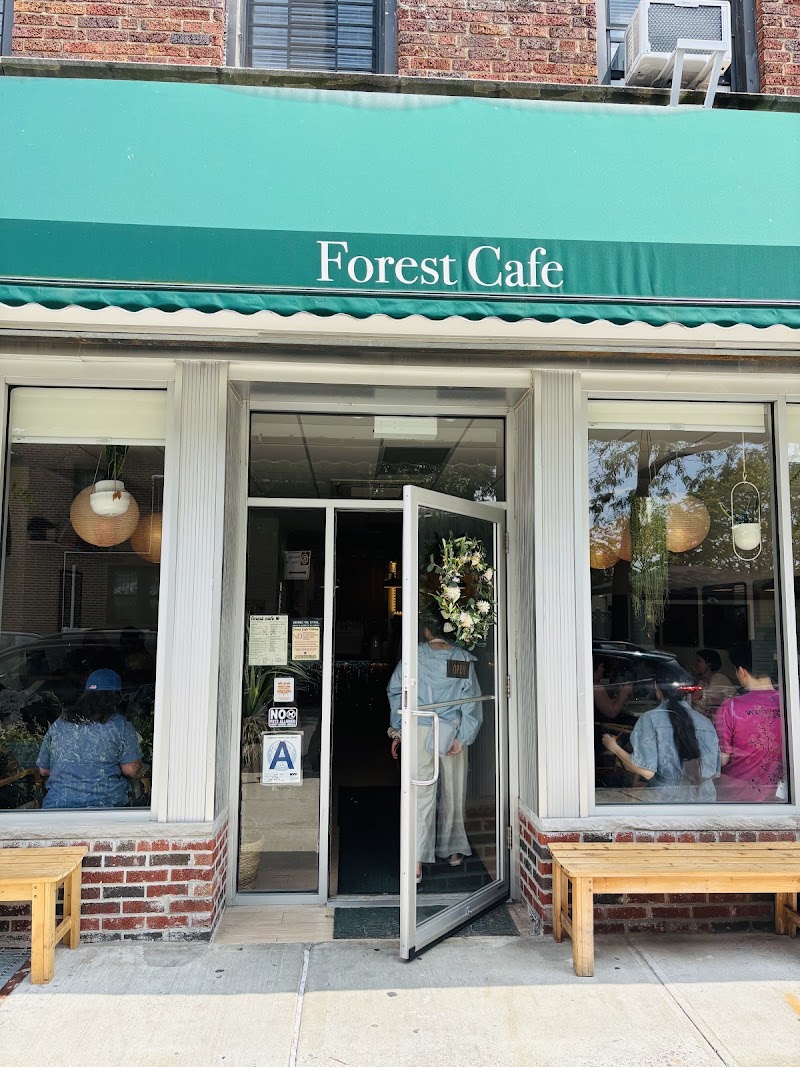
Bright, spacious and deliberately soft — the founders describe the aesthetic as a blend of Japanese and Scandinavian minimalism, and the execution is more personal than that phrase usually implies. Paper lanterns hang from the ceiling, turquoise paper decorations sit at the front, and plants are everywhere: cacti, snake plants, and trailing string-of-turtles. Mirrors take up one wall; small star and leaf emblems edge the others, and a short shelf carries a few Buddha figures. Seating runs from booths through stools to window benches and cushioned chairs, so the room accommodates both a group and a solo laptop session without either feeling wrong. The exterior canopy and the residential setting — a laundromat on one side, a school nearby, apartment buildings all around — give it a quiet that a main-street café simply cannot buy. On weekends that quiet disappears, and the room is busy and cheerful instead.
Beyond coffee
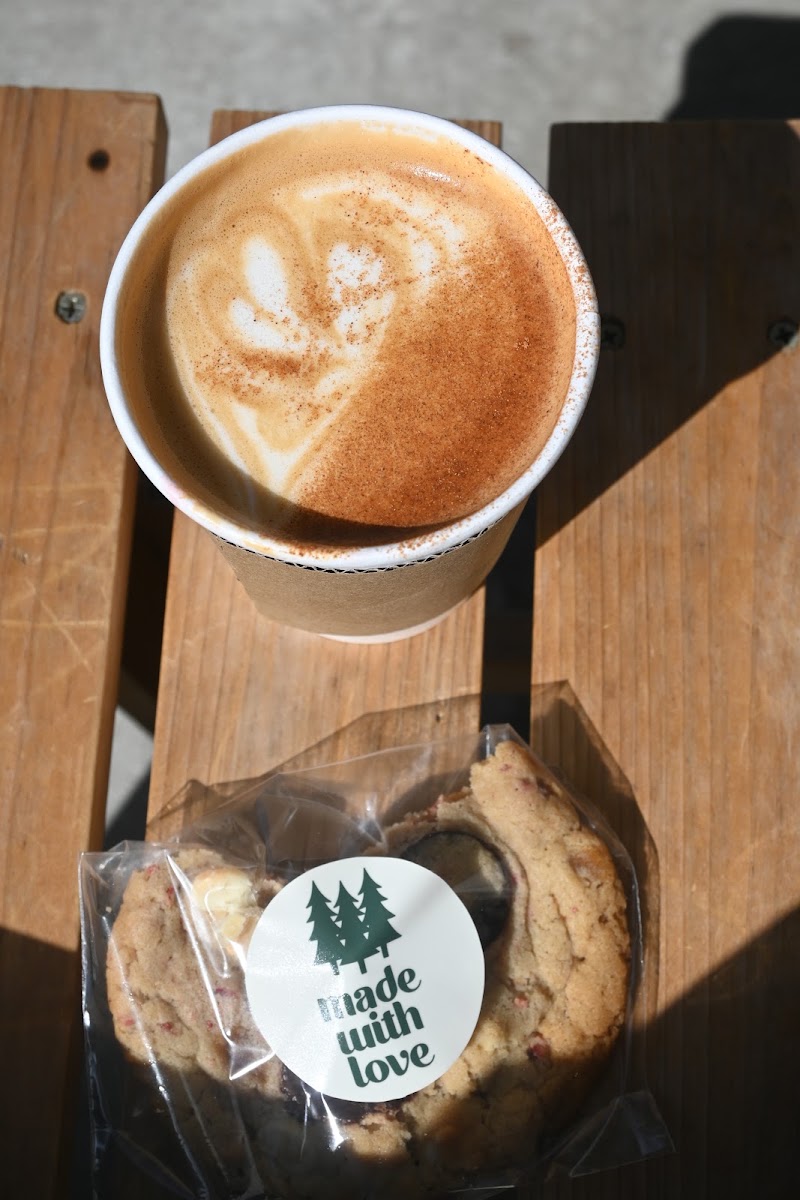
The café bakes, and this is not a token pastry case. Croffles are made fresh daily and run through a short rotation of flavors. Beyond them, the counter carries house-made cookies, mochi and cakes — the pandan butter mochi with toasted coconut, the strawberry chunk cookie, the earl grey chocolate chunk cookie and the carrot cake with cream cheese frosting all have their own partisans, and the muffins are the item regulars insist is underrated. There is no cooked brunch menu and no full kitchen: this is a bakery counter attached to a coffee bar, not a restaurant. For a café of this size, though, the baking is unusually serious, and a good share of the traffic comes in for it rather than for the coffee.
When to come
Mornings on weekdays are the calmest and the best window for anyone planning to work. Weekend late mornings and midday are the peak, with a line that regulars insist moves quickly — the staff are used to the volume, but the hand-whisked drinks set a ceiling on how fast anything can go. This is a daytime café: it winds down in the afternoon and does not trade in the evening, so it is not an option for a night out. If you want the room at its most neighborhood-like, come on a weekday between the morning rush and the school run.
Getting there
Forest Hills, on a residential block a short walk from the 67th Avenue station on the M and R lines. The larger 71st–Continental Avenue hub, served by the E, F, M and R, is a slightly longer but easy walk, as is the Long Island Rail Road station. The main Forest Hills shopping strip and the stadium are both within a few minutes on foot, which means you can pair a visit with almost anything else in the neighborhood. Note that the café is not on the shopping strip itself — you turn off it into the residential grid, and the block looks quiet enough that first-timers occasionally think they have the wrong address.
Good to know
Expect to queue on weekends; the trade-off for hand-whisked drinks is time. Seating is real but finite, and at peak the wait for a table is longer than the wait for a drink. Ask about the secret menu and the seasonal specials — the printed board is not the whole offer. The room is bright and fairly open, so it is a good place for focused work and a mediocre place for a private conversation on a busy day. And plan around the afternoon close: this is not somewhere you can drift into after work.
Questions and answers
Who runs it?
Sisters Julie and Nina Fung along with Nina’s fiancé Paul Shim — an Asian-American family who had lived in Forest Hills for about a decade before opening in October 2022.
Is it good for working on a laptop?
Yes, and that was the founding purpose. Free Wi-Fi, charging outlets and several seating types, with no pressure to leave. Weekday mornings are the best window.
Why is the matcha talked about so much?
Because it is hand-whisked to order rather than batched in advance. That is unusual at this volume, and it is the main reason people travel here from other boroughs.
What is a croffle?
A croissant pressed in a waffle iron — a staple of Korean café culture. They are made fresh daily here in a short rotation of flavors.
Whose coffee do they use?
Project X Coffee: Brazilian beans roasted in Chicago, with a house style shaped by Japanese coffee culture. Forest Cafe does not roast its own.
Can I come in the evening?
No. This is a daytime café that closes in the afternoon and does not run evening service.
Which subway is closest?
The 67th Avenue station on the M and R is nearest; the 71st–Continental Avenue hub with the E, F, M and R is a slightly longer walk.
Opening hours
| Day | Hours |
|---|---|
| Monday | 08:00–16:00 |
| Tuesday | 08:00–16:00 |
| Wednesday | 08:00–16:00 |
| Thursday | 08:00–16:00 |
| Friday | 08:00–16:00 |
| Saturday | 09:00–16:00 |
| Sunday | 09:00–16:00 |
Photos
Visitor reviews
Reviews last updated: 2026-08-10 16:27:16
Data is refreshed monthly. Sources: queenska.com and editorial picks based on reviews.
Це просторе кафе має виразну жіночу чутливість, добре інтегроване в житловий район. Оточене будинками, проте розташоване поруч із пральнею та школою, а не на комерційній головній вулиці, воно культивує тиху сусідську атм…
Одна з моїх улюблених кав'ярень у місті! Кожна нова страва, яку я куштую, стає моєю новою улюбленою. Більше людей точно повинні спробувати їхні мафіни – вони дуже недооцінені. Ідеальне середовище для роботи!
forest cafe is clearly a warm and intentional space filled with love. people come from all over the boroughs for their drinks (with evident good reason)!
prepare to stand on a line on the weekends – which moves fast! ev…
Це нова улюблена місцева кав'ярня, яка безперечно варта всієї цієї реклами. Атмосфера така тепла та затишна, щойно заходиш. Мені дуже сподобався звичайний кроффл, убе лате та хорії матча лате з лавандовим сиропом. Касир…
Банановий лате з коричневим маслом чудовий! Все чудово поєднувалося, а сам напій був ідеально солодким. Банановий смак був більш ледь помітним. Спочатку я відчувала смак коричневого масла, а потім бананового післясмаку.…