

Café · Queens · ⭐ 9.5/10 · 979 reviews · updated: 2026-08-10 16:27:13
Address: 22-37 31st St, Astoria, NY 11105, United States
Coffee did not start in Italy, and Qahwah House exists largely to make sure you know it. The word itself is Arabic; the drink was cultivated and traded out of Yemen for centuries before Europe had a name for it. This Astoria location belongs to a family that has been farming coffee in the Yemeni highlands for eight generations, and it pours the results of those farms in a bright room with a glass-roofed garden at the back — an amount of space no café in this part of Queens has any business having.
Highlights
- Beans from the family’s own farms in Haraz. The Yemeni highland region sits at roughly 2,500 meters, and the coffee is grown, harvested and shipped from land the founder’s family has worked for eight generations.
- Jubani, served with honey instead of sugar. Brewed from the coffee husk rather than the bean, spiced with cardamom, ginger and cinnamon, it is the drink that most clearly separates this from a Western café.
- A glass-roofed garden at the back. The rear conservatory opens to the sky and looks onto trees — genuinely rare in a neighborhood where most cafés are one narrow room.
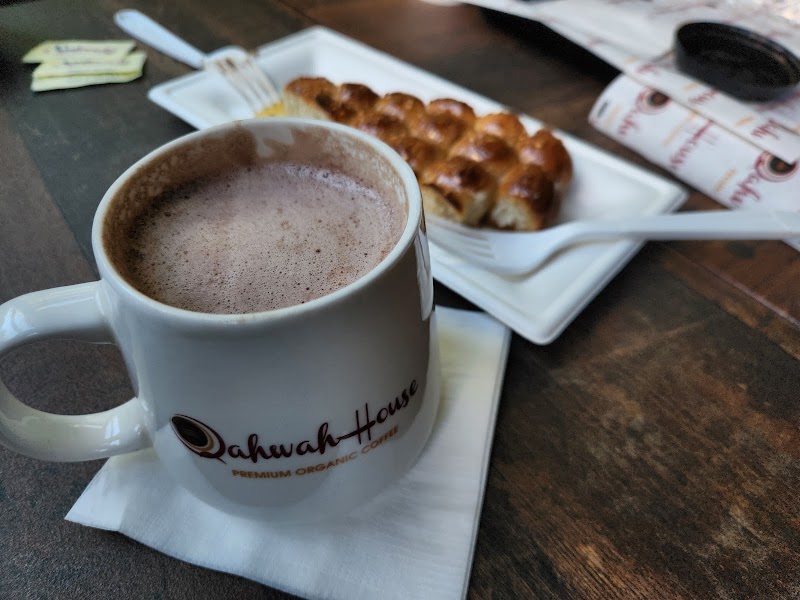
- Khaliat al nahl, brought out warm. Yemeni honeycomb bread, pulled apart into cream-cheese-filled buns and drenched in honey, is the pastry the room is built around.
- Alcohol-free and open very late. The café runs until around midnight and later at the end of the week, which makes it a full evening venue rather than a daytime stop.
- Space, and lots of it. Indoor seating plus the garden gives the place a capacity that Astoria’s other coffee rooms simply cannot match.
What’s in the cup
This is the rare café where the origin story is not marketing but the actual supply chain. The Alhasbani family has cultivated arabica in Yemen’s highlands for eight generations, and the beans poured here come from the family’s farms in the Haraz region — high, cool at night, wet in summer, which is close to the textbook description of ideal growing conditions. The coffee is organic and roasted in small batches, and the Yemeni style leans toward dried fruit, chocolate and spice rather than the sharp citric brightness of a modern light roast.
The menu is organized around traditional preparations, and they are worth learning. Mofawar is the house coffee served hot and aromatic. Jubani is not made from the bean at all but from the husk — qishr, the dried fruit shell — infused with cardamom, ginger and cinnamon and sweetened with honey rather than sugar, which is why it tastes closer to a spiced tisane than to coffee. Adeni chai is the milk tea of Aden, heavy with cardamom. There is Yemeni tea, an iced Yemeni latte that has become the crossover order, and Turkish coffee for people who want something adjacent but familiar.
The espresso-and-syrup half of the menu exists, and it is the weaker half. The pistachio latte is well balanced; the caramel macchiato runs sweet enough that regulars flag it. That imbalance is not a flaw so much as a signpost: this café is at its best doing the thing nobody else nearby can do. The founder’s stated mission is to build enough American demand for Yemeni coffee to rebuild the farms back home, and every traditional drink on the list is part of that argument.
Who’s behind it
Ibrahim Alhasbani opened the first Qahwah House in Dearborn, Michigan in 2017, a few years after leaving Yemen when a bomb went off near his home. He came from a coffee-farming family — eight generations of it — and built the business around selling what his own land produces rather than buying on the commodity market. The company has since grown past thirty locations across the United States, with more in progress, and Alhasbani has been explicit that the goal is not a café empire for its own sake but demand: enough of it to make Yemeni coffee farming viable again.
The Astoria site is family-operated in the day-to-day sense too, and visitors regularly note that the people behind the counter will talk at length about Yemen, about why the coffee tastes the way it does, and about what each traditional drink is. That is part of the format rather than an accident — the whole model assumes the customer arrives knowing nothing about Yemeni coffee and leaves knowing something.
What it’s for
The dominant scenario is the long evening conversation. This is a room designed for people to sit in for two or three hours, without alcohol, without a table time limit, and without the dinner-service pressure of a restaurant. Groups meet here after work and after dinner; families come with children; friends who have not seen each other in months pick this over a bar. That is the core of it, and it is why the space is so large.
Laptop work is viable, and the back garden is where it happens — regulars describe it as the section that gets claimed by people working. Wi-Fi is available and the staff do not rush long sitters, which matches the format everywhere else in the group. Power is the usual café caveat: sockets are not under every seat, so pick your table for the wall rather than the view if you are running on battery. Mornings and early afternoons are quiet enough for real concentration; evenings are not.
Takeaway works smoothly and a substantial share of the traffic is people carrying a jubani or an iced Yemeni latte out the door. But this is not primarily a grab-and-go café — the whole point of the room, and especially of the garden, is that you stay in it.
The space
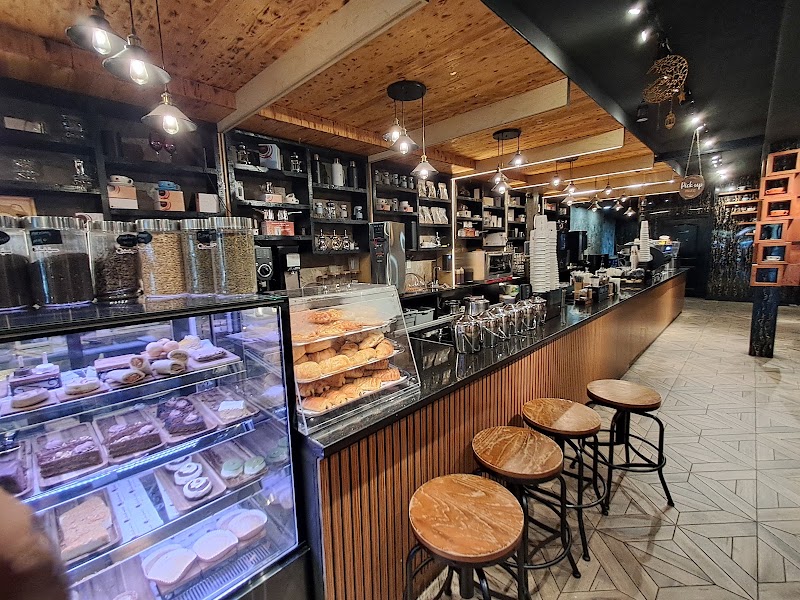
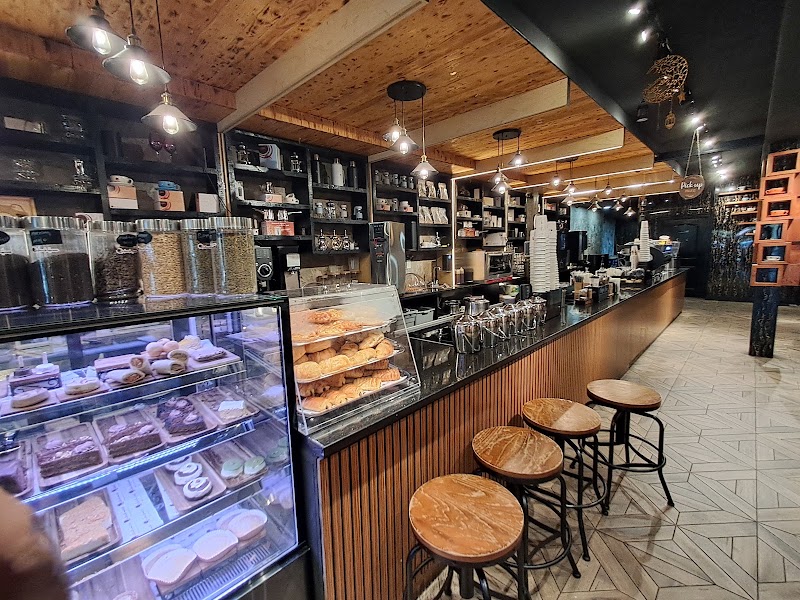
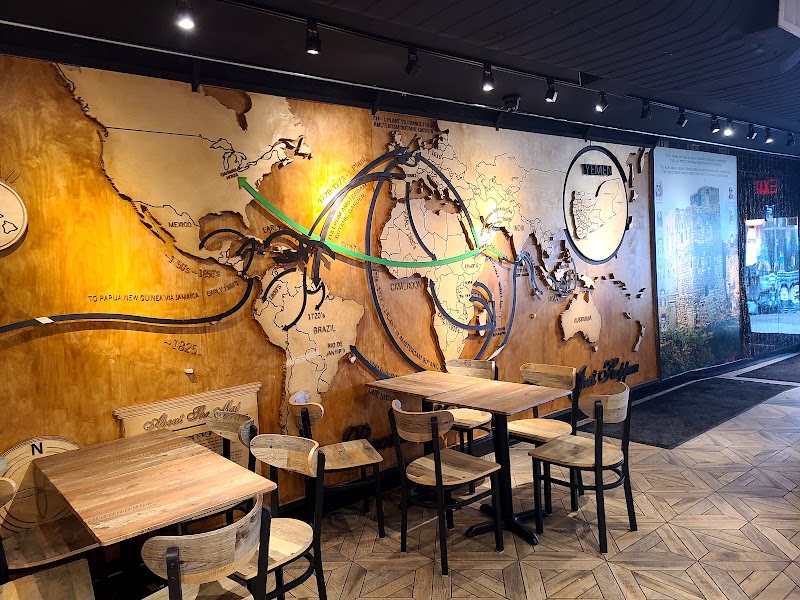
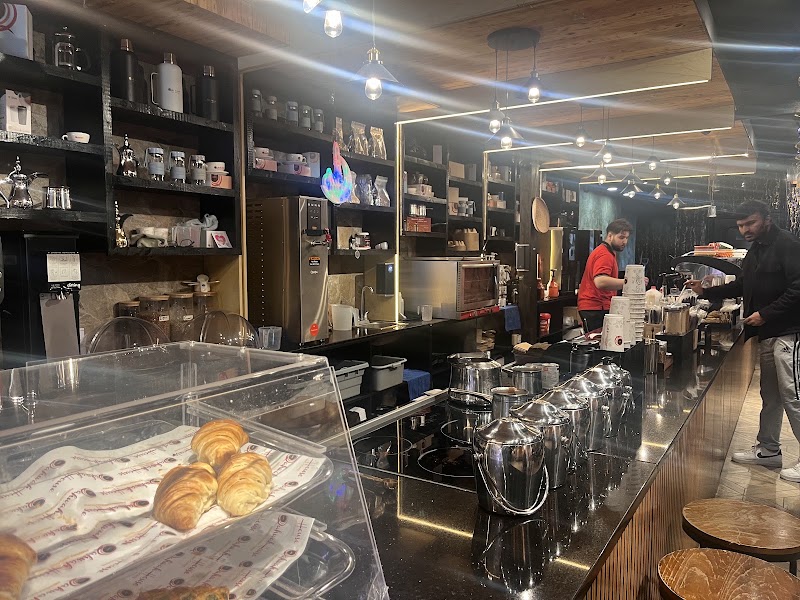
Large, bright and considerably more elegant than the neighborhood average: big windows, careful decoration, and a layout that gives you actual room between tables. The signature element is at the back — a conservatory with an open glass roof that looks onto trees, which turns what would be a standard rear extension into the most sought-after seating in the place. There is outdoor seating as well, so on a decent day the café effectively doubles.
Capacity is the quiet advantage. Astoria’s coffee rooms are, as a rule, tight; this one has enough seating that arriving with four people is not a gamble. The atmosphere is warm and social rather than hushed, and it gets loud late in the evening when the room is full. It is spotless, it is welcoming to people who have never encountered Yemeni coffee before, and the service is consistently described in the same terms — patient, explanatory, unhurried.
Beyond coffee
The food is Yemeni and it is not an afterthought. Khaliat al nahl — honeycomb bread — is the anchor: a tray of soft dough balls filled with cream cheese, baked together and finished with honey, served warm and pulled apart by hand. Sabaya, the layered honey pastry, sits alongside it, and there is a broader run of traditional sweets meant to be eaten with spiced tea rather than admired on a plate.
Everything is halal and there is no alcohol on the premises. One honest note from regulars who know the group’s other locations: the honeycomb bread here has been criticized for arriving over-honeyed and less crisp than at the older Long Island site, so freshness on that particular item can vary. The lavender lemonade, by contrast, gets consistently good notices from people who did not expect to like it.
When to come
The café opens early — before the working day starts — and the morning is the quietest and most functional stretch: this is when to come if you want the garden to yourself, a table for a laptop, or a slow first cup. Weekday afternoons remain calm.
Evening is the main event. From dinner onward the room fills with the crowd it was built for, and it keeps going to around midnight, later at the end of the week, long past the point where the rest of the neighborhood’s cafés have closed. Weekend nights are the busiest and the best for atmosphere; if you want quiet, that is exactly when not to come. The garden is weather-dependent in the practical sense, though the glass roof extends its season well beyond an open patio.
Getting there
The café sits in the northern half of Astoria, close to the Ditmars end of the neighborhood, on the corridor where the elevated N and W tracks run overhead. It is a short walk from either the Astoria Boulevard or the Ditmars Boulevard station, and the elevated structure is the landmark you navigate by — you will hear the trains from the front tables.
Buses cross the area in both directions, and the highway network and both airports are close, which is why the café also picks up traffic from people passing through rather than living here. Curbside parking is realistic outside peak evening hours. The entrance is at street level.
Good to know
Come knowing that the interesting half of the menu is the traditional half. If you order an iced caramel drink you will get a sweet iced caramel drink; if you order jubani, mofawar or adeni chai you will get something you cannot buy from a chain, and staff will happily explain what you are drinking. Asking is normal here and is part of the experience.
Two caveats worth stating plainly. Qahwah House is now a large and fast-growing group — past thirty locations — and consistency between sites is not perfect; the same item has been judged better at older branches. And the room is alcohol-free by principle, which for most of its regulars is the entire appeal, but is worth knowing if you were expecting a wine list with your evening.
Questions and answers
What is jubani, and why does it not taste like coffee?
Because it is not made from the bean. Jubani is brewed from qishr — the dried husk of the coffee fruit — with cardamom, ginger and cinnamon, and it is served with honey instead of sugar. It sits closer to a spiced infusion than to espresso, and it is the single most distinctive thing on the menu.
Where does the coffee actually come from?
From the founder’s family farms in the Haraz highlands of Yemen, at roughly 2,500 meters. The family has grown coffee there for eight generations, and the beans are organic and roasted in small batches.
Is there outdoor or garden seating?
Yes, and it is the best part of the café. There is a rear conservatory with a glass roof open to the sky and a view onto trees, plus outdoor seating — an unusual amount of space for a neighborhood where cafés are typically cramped.
Can I work here on a laptop?
Yes, particularly in the back. The garden is where the working crowd tends to settle, Wi-Fi is available, and nobody moves you on. Outlets are not everywhere, so choose a seat with power in mind. Mornings and early afternoons are the quiet windows.
Do they serve alcohol?
No. The café is alcohol-free and the food is halal, which is a large part of why it functions as an evening destination for people who do not drink.
How late is it open?
Very late by neighborhood standards — around midnight most nights and later at the end of the week. That is when the room is at its fullest and liveliest, and also when you are most likely to wait for a table.
What should I eat?
Khaliat al nahl, the honeycomb bread, is the signature — soft cream-cheese-filled buns finished with honey and served warm. Ask for it fresh; reports on this item are the one place where quality has been inconsistent.
Is this a chain?
It has grown into one — past thirty locations nationwide since the original opened in Dearborn, Michigan in 2017 — but it is a single family’s operation built on a single family’s farms, which is not the usual meaning of the word. The Astoria site is one of the larger and better-appointed rooms in the group.
Opening hours
| Day | Hours |
|---|---|
| Monday | 07:00–00:00 |
| Tuesday | 07:00–00:00 |
| Wednesday | 07:00–00:00 |
| Thursday | 07:00–00:00 |
| Friday | 07:00–01:00 |
| Saturday | 07:00–01:00 |
| Sunday | 07:00–00:00 |
Photos
Visitor reviews
Reviews last updated: 2026-08-10 16:27:13
Data is refreshed monthly. Sources: queenska.com and editorial picks based on reviews.
Я досі пам'ятаю, як подорожувала аж до Мічигану, щоб відвідати Qahwah House, бо закохалася в їхню каву та десерти. Ніколи не уявляла, що одного дня вони відкриють заклад у моєму улюбленому районі — Асторії.
Щиро кажучи,…
Яке чудове місце. Таллал розповів про те, що Ємен є однією з батьківщин кави та чим вона відрізняється від кави з інших країн. Скуштував єменський чай, випив чудову каву Мофавар та скуштував Халіат аль Нахль, єменський х…
Це останнє доповнення до дивовижної пекарні та кави в Джексон-Хайтс. Вона велика та світла, і, що найважливіше, наповнена фантастичною кавою (європейською та єменською), чаєм та іншими напоями. Пекарня повна традиційної,…
У суботу вранці зустрівся тут з другом на каву. Було чудово, і розташування було супер зручним. Тут купа місця як зовні, так і всередині — особливо чудово для району, де кав'ярні здаються дуже тісними. Мені тут дуже подо…
Така ж атмосфера та гарне обслуговування клієнтів, як і в їхньому ресторані у Вестбері. Це був наш перший раз в їхньому ресторані в Асторії.
Ми вперше спробували лавандовий лимонад, він був неймовірно смачним. Також ми…