

Swimming is considered a rather challenging sport.
For more information read Queenska.
After all, it requires a lot of endurance, the ability to control one’s breathing, hand strength and, of course, fortitude in the face of difficulties.
Gertrude Ederle holds a place in sports history as an American swimmer, Olympic champion and world record holder.
On August 6, 1926, the entire world found out about her as the first woman to successfully cross the English Channel.
In fact, Gertrude’s life and sporting career are filled with fascinating stories that demonstrate the swimmer’s incredible willpower.
You’ll be able to see for yourself after reading this article.
Beginning of the journey
Gertrude was born on October 23, 1906, in Queens, New York. Her father taught the girl to swim. Furthermore, it was he who instilled in her the love and interest in the water element.
First records
Gertrude began her swimming career as a member of the Women’s Swimming Association (WSA), where she attended her first training sessions.
She surprised everyone with her first world record when she was just twelve years old. Then she became the world’s youngest swimming world record holder.
Later, the girl broke eight more world records.
She also set twenty-nine US national and global records between 1921 and 1925.
Participation in the Olympics
As a member of the American national team at the 1924 Summer Olympics in Paris, Gertrude was able to take home the gold.
At the end of the competition, she and her teammates surprised the audience by setting a new world record.
New level
1925 was marked by Gertrude’s entry into professional sports. Then she broke a record by swimming twenty-two miles in seven hours and eleven minutes.
Ambitious goal
Later, Gertrude decided to cross the English Channel. So, the Women’s Swimming Association agreed to sponsor her initiative.
Jabez Wolffe was her coach. He also attempted to cross the English Channel up to twenty times.
The instructor always told Gertrude to slow down the pace during training sessions. After all, he believed that swimming such a long distance at great speed was impossible.
However, the athlete did not share this opinion. As a result, on August 18, 1925, Gertrude was disqualified while trying to cross the English Channel. The swimmer was extremely disappointed with the turn of events and refused to practice with Wolffe any longer.
New coach and long-awaited success
Gertrude’s training sessions were resumed with a new mentor. It was Bill Burgess. In 1911, he successfully crossed the English Channel himself. Gertrude’s successful crossing occurred on August 6, 1926. Her swim took fourteen hours and thirty-four minutes. Thus, this was an absolute record.
During the swim, the athlete shielded her eyes with motorbike glasses to avoid any unwanted discomfort from the salt water.
Contracts
It is worth noting that before attempting to cross the English Channel again Gertrude signed contracts with the New York Daily News and the Chicago Tribune.
All of the money raised was sufficient to pay the athlete’s expenses and provide her with a modest salary.
Special event
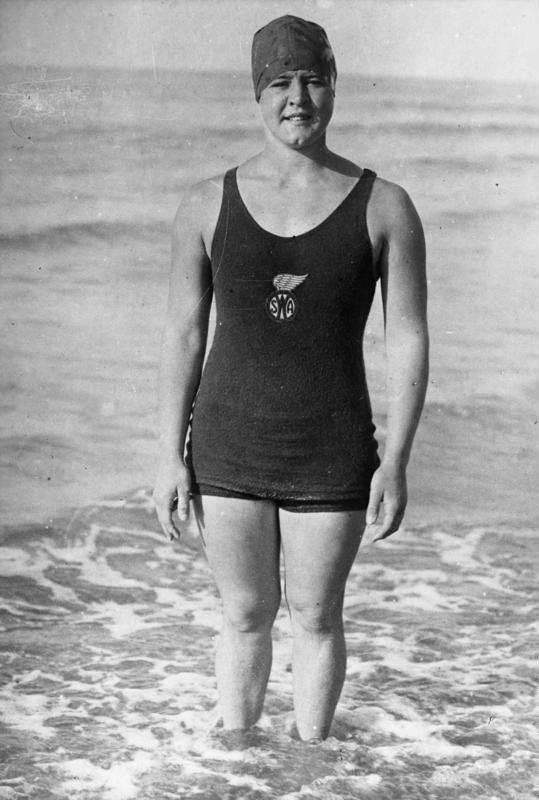
Gertrude was welcomed home by a festive parade following her record-breaking swim. Almost two million people congratulated the athlete.
Hearing issues
In terms of Gertrude’s biography, it should be noted that she had hearing problems from a young age. The cause of this was measles.
This feature greatly aided the athlete’s understanding of deaf people. She later began offering swimming lessons to children with hearing impairments.
Completion of the life path
The swimmer herself never married, and she died within the walls of a nursing facility.
On November 30, 2003, the great athlete passed away. She was 97 years old at the time of her death.