

Café · Queens · ⭐ 9.5/10 · 1103 reviews · updated: 2026-08-10 16:27:13
Address: 25-73 Steinway St, Astoria, NY 11103, United States
Most New York cafés surrender the evening to bars. MOKAFÉ was built on the opposite assumption — that a large share of the neighborhood does not drink, and that those people still want somewhere to be at ten at night. It opened in November 2023 on the Arab and North African commercial strip of Astoria that everyone here calls Little Egypt, a few blocks from the apartment where the founding family grew up, and it has spent since then proving that a Yemeni coffeehouse can hold a room long after the espresso machines elsewhere have been wiped down for the night.
Highlights
- A genuinely alcohol-free evening room. This is the rare café that treats late hours as its core business rather than an afterthought, which is why it functions as a third place for Astoria’s Muslim and Arab community rather than just a coffee stop.
- Yemeni and Guatemalan farms, named out loud. The café works directly with growers in both countries and puts photographs of the Yemeni farmer who grew the beans on the wall instead of hiding origin behind a house blend.
- Adeni chai. Black tea with cardamom and milk, made the way it is made in Aden — the single order that tells you this is not a Western café with an Arabic name.
- Sabayah baked from a family recipe. The layered honey cake comes from the founder’s mother, and it is the pastry the room was designed around.
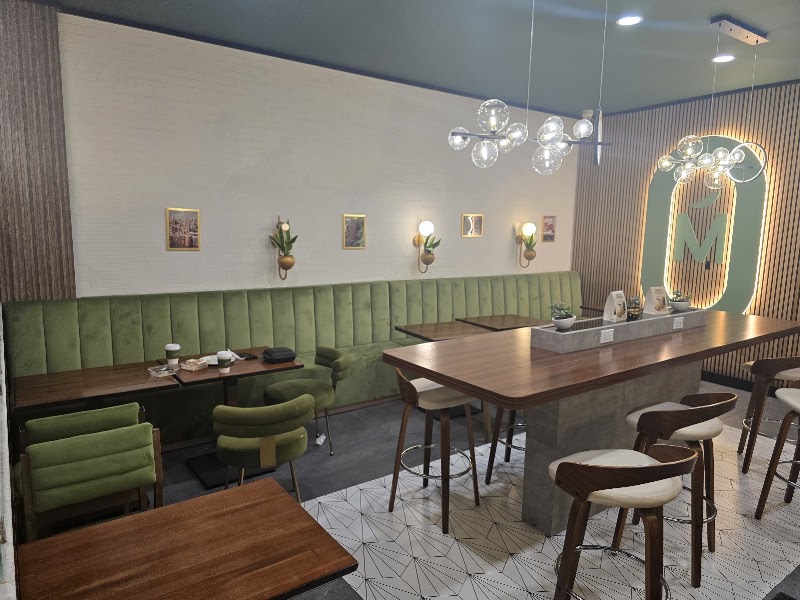
- Bleacher seating and Yemeni tilework. The interior deliberately collides two identities: Islamic-pattern tile and photographs of Yemen on one side, stadium-style stepped seating borrowed from New York ballparks on the other.
- A quiet room at the back. Behind the main floor there is a separate calmer space, which is where the students who spend whole afternoons here end up.
What’s in the cup
Mokafé’s coffee program is unusual in that it runs on two origins at once, and says so. On the Yemeni side the café buys from partner farms in the country generally credited as the birthplace of the drink — the high, terraced plots where coffee was cultivated for export centuries before anyone in Europe had tasted it. On the Guatemalan side the sourcing was built with a coffee scientist from that country, which is how the café arrived at a farm-to-cup model rather than a wholesale contract. The founders describe the point as refusing to be anonymous: the grower is shown, not implied.
In the cup that produces two quite different experiences. The traditional Yemeni preparations are spiced, aromatic and less about extraction technique than about ritual — cardamom is a structural ingredient, not a flavoring, and the tea and coffee sides of the menu are treated with equal seriousness. The espresso side is contemporary and milk-forward: oat lattes are ordered as often as dairy, and the flavored lattes (pistachio, biscoff, salted caramel) are what most first-timers pick up.
Honesty about that second half matters. The flavored drinks are the weaker half of the menu and the place where the criticism lands — the salted caramel is repeatedly described as short on salt, and the sweeter matcha builds can arrive tasting more of syrup than of tea. Order across the Yemeni side of the list and the café is doing something no chain nearby is doing; order the same latte you would order anywhere else and you will get a competent version of it, nothing more.
Who’s behind it
The café was founded by the Mubarez family, and the public face of it is Youssef Mubarez, whose parents emigrated from Yemen in the 1970s and raised their children a few blocks from where the café now stands. That is not decorative backstory — it explains the site choice. The family was already embedded in the Arab community along this strip, so opening the flagship here was, in Youssef’s telling, never really a decision.
The sourcing side was shaped in partnership with Jorgé Ciciliani, a Guatemalan coffee scientist with more than a decade in the industry, which is why the Guatemalan half of the program is as considered as the Yemeni half rather than being filler. Two locations opened simultaneously — this one and a sibling in Paterson, New Jersey, another major hub of Arab and Muslim life — and the brand has since grown to roughly ten sites across New York and New Jersey, with franchising now on offer. Astoria remains the original and the one with the family history attached.
What it’s for
Two scenarios dominate, and they split by time of day. Until the early evening this is a working and studying café, and a well-equipped one: the Wi-Fi is free, the staff are fast and unbothered by long sits, and the quiet back room exists specifically so that people can concentrate. Regulars report studying here for hours without anyone hinting that they should move along, which in a room this popular is a deliberate policy rather than an accident.
Power is the one genuinely contested point, and reports conflict. Some regulars describe outlets distributed throughout the room; at least one visitor found almost nothing working outside a single socket in the quiet room. Treat the café as laptop-friendly but battery-uncertain — arrive charged, and if you need power, head straight to the back rather than settling on the bleacher seating.
After dark the room changes function entirely. It becomes a meeting place — groups, families, friends who want somewhere to sit and talk for two hours without a drinks minimum and without alcohol in the room. That is the scenario Mokafé is genuinely best at, and it is also when it is most crowded; late evening is when you are most likely to circle for a table. Takeaway is quick and well organized, and several of the brand’s other sites are built for exactly that, but the Astoria flagship is designed for staying.
The space
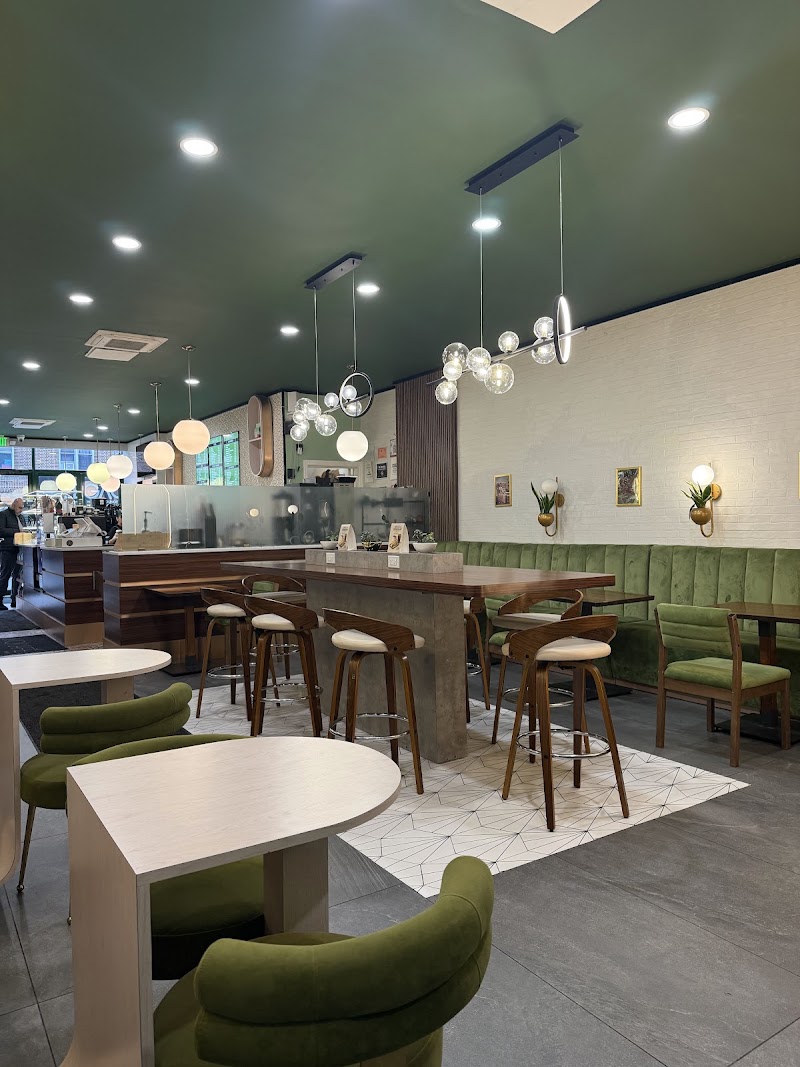
The interior is the least generic thing about the café. Islamic-pattern tilework and photographs of Yemen and its farmers set the register, and the logo carries the dragon blood tree — the umbrella-shaped endemic tree of Socotra that functions as a national emblem. Against that, the seating is a joke about New York: stepped bleacher benches modeled on ballpark stands, which turn the main floor into something between a café and a small amphitheater.
Capacity is generous, with a lot of seating for the neighborhood, and the layout separates loud from quiet. Tables toward the back escape the street noise almost entirely, and the calmer room behind them goes further still. The main floor is warm, bright and busy; it can get genuinely loud on a weekend night, when the room fills with the crowd that has nowhere else to be. It is clean, well kept, and — an underrated point in a café that trades on hospitality — the service holds up under pressure.
Beyond coffee
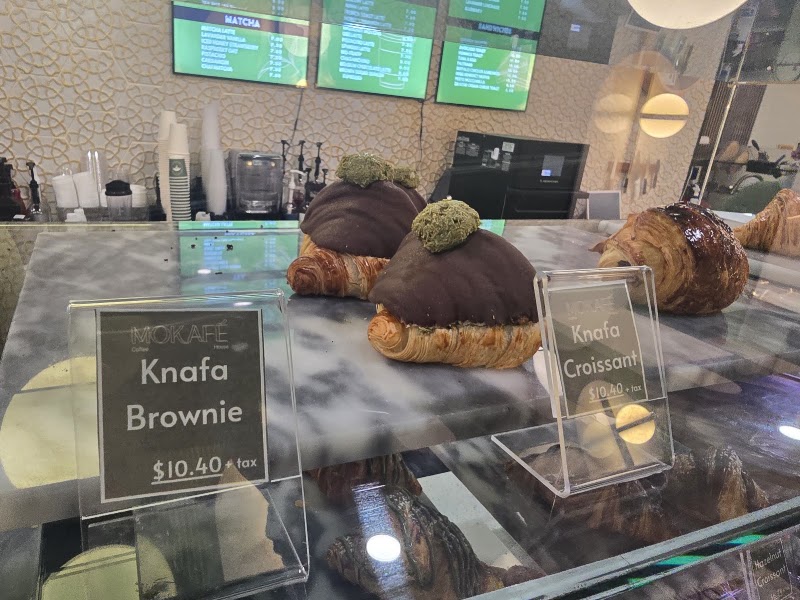
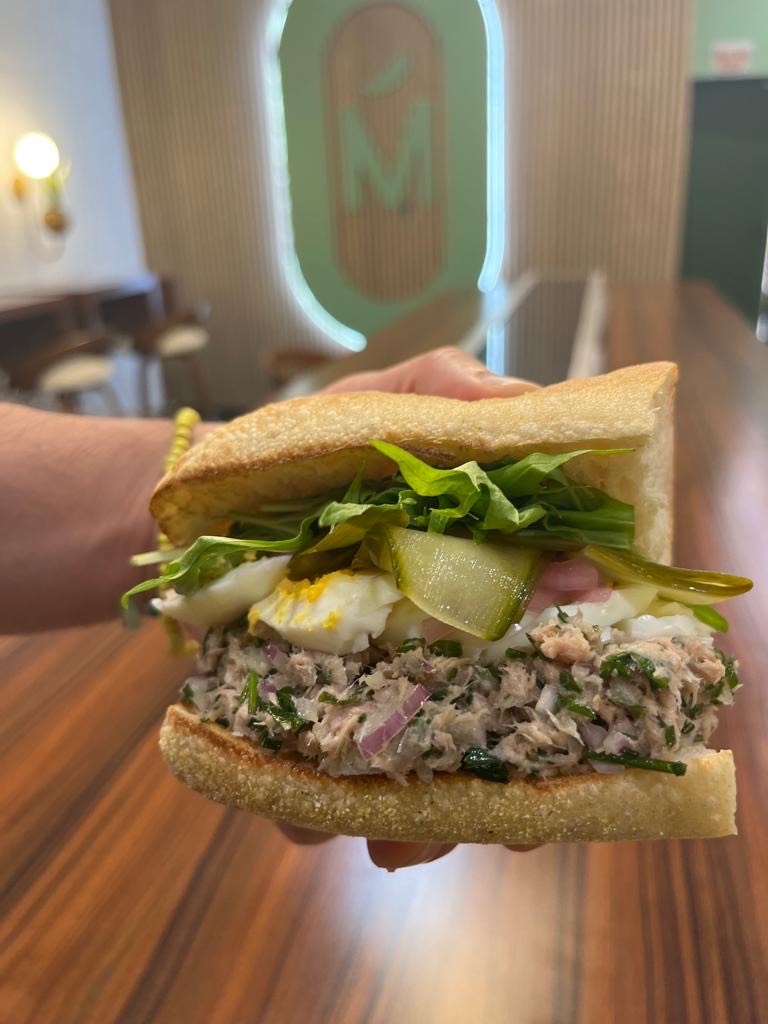
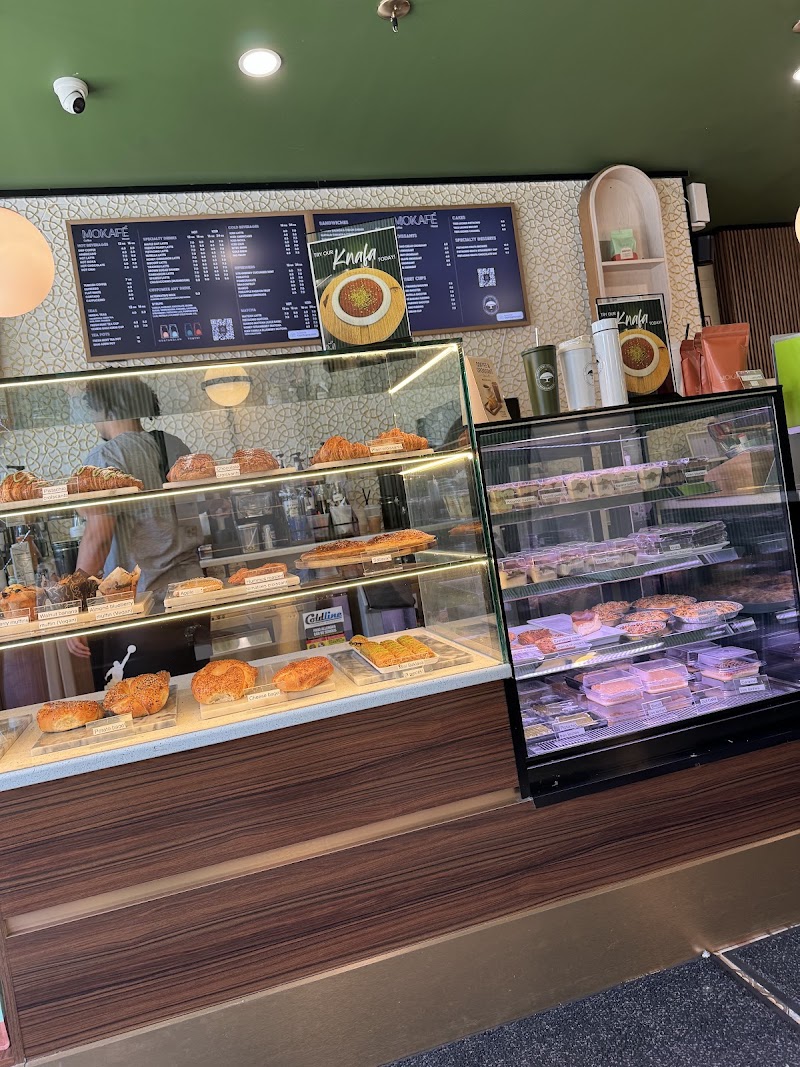
Food here is central, not decorative, and it splits the same way the drinks do. The traditional side is anchored by sabayah, the layered honey cake made to the founder’s mother’s recipe, alongside Middle Eastern cheesecakes and the sweet things that belong with spiced tea. The café side runs pistachio croissants, an olive bagel that regulars single out, pistachio tiramisu and a short savory list built around avocado toast — worth knowing that the avocado toast arrives with real heat, which surprises people who did not order it expecting spice.
Baking quality is the consistent praise in the room: pastry is fresh, the croissants are fragrant rather than stale-sweet, and the cakes are made to be eaten with tea rather than photographed. There is no alcohol and there is no hookah, despite the pipes displayed on the walls as decoration.
When to come
Morning opens well before the working day starts, and the first stretch is the calmest — this is the window for laptop work, a quiet cup, or a table to yourself in the back. Weekday afternoons stay workable and are the best time if you actually intend to get something done.
The evening is the café’s signature and its crush. From dinner time onward the room fills with people who came specifically to sit and talk, and it stays that way until closing, which is much later than the neighborhood norm — later still at the end of the week, when the café keeps going well past the point where the rest of the strip has locked up. If you want the atmosphere, come then; if you want a table without waiting, do not.
Getting there
The café sits in Little Egypt, the Arab and North African commercial spine of Astoria — an unmistakable stretch of halal butchers, hookah lounges, bakeries and phone shops that has been the neighborhood’s Middle Eastern center for decades. From the Astoria Boulevard stop on the N and W it is a walk of a few blocks east; the elevated line is the landmark you orient off.
Buses run the length of the strip and the highway network is a few minutes away, so driving in from elsewhere in Queens is straightforward, though curbside parking on the commercial blocks is competitive at night. The entrance is at street level.
Good to know
The café is alcohol-free, and that is the point rather than a limitation — it is precisely why the room fills with people who would otherwise have nowhere to go after dark. It also means the evening crowd skews young and social, and the volume rises accordingly; this is not a silent reading room at eleven at night.
Two practical warnings. Sweetness is calibrated high across the flavored drinks, so ask for less if that matters to you. And Mokafé is now a growing group with sites across two states and franchises on offer, which means the flagship’s atmosphere is not automatically what you get at every branch — the Astoria room, with its family history and its tile, is the original and remains the reference point.
Questions and answers
What should I order to understand what this place actually is?
Adeni chai and sabayah. The spiced milk tea and the layered honey cake are the Yemeni core of the menu and the two things you cannot get from a generic café; the flavored lattes are competent but interchangeable with anywhere else.
Is it good for working on a laptop?
Yes during the day, with a caveat about power. Wi-Fi is free, the staff do not push long sitters out, and there is a quieter room behind the main floor. Outlets are the weak point and reports on them conflict, so arrive charged and sit at the back if you need a socket.
Do they serve alcohol?
No. The café is deliberately alcohol-free, which is central to its role as a late-night gathering place for the neighborhood’s Muslim and Arab community.
Is there hookah?
No. Pipes appear on the walls as decoration, but the café does not serve shisha — worth knowing on a strip where many of the neighbors do.
Is this a chain?
It has become a small group — roughly ten locations across New York and New Jersey, with franchising available. The Astoria site is the flagship, opened by the founding family a few blocks from where they grew up, and it is the one with the full room, the tilework and the back garden of the concept.
How late does it stay open, and how busy is it then?
Much later than most cafés in the area, and later still at the end of the week. Evening is when the room is at its fullest and most characteristic; expect noise and possibly a wait for a table.
Where does the coffee come from?
From partner farms in Yemen and in Guatemala, with the growers named and photographed rather than anonymized. The Guatemalan side of the program was built with a coffee scientist from that country.
Is it suitable for children or families?
Yes — the absence of alcohol and the generous seating make it a normal place for families to sit in the evening, which is a large part of why it fills up the way it does.
Opening hours
| Day | Hours |
|---|---|
| Monday | 08:00–23:00 |
| Tuesday | 08:00–23:00 |
| Wednesday | 08:00–23:00 |
| Thursday | 08:00–23:00 |
| Friday | 08:00–02:00 |
| Saturday | 08:00–02:00 |
| Sunday | 08:00–23:00 |
Photos
Visitor reviews
Reviews last updated: 2026-08-10 16:27:13
Data is refreshed monthly. Sources: queenska.com and editorial picks based on reviews.
Тихе та чисте місце,
Рекомендую вам піти до задніх столиків, ви забудете про шум вулиці!
Кава була смачна тільки тост з авокадо був гострим, якщо ви не їсте гостру їжу… крім цього, мені сподобалося це місце
Мені дуже сподобалося це кафе! Оливковий бейгл – просто неймовірний. Смачний та пухнастий. Також спробуйте тірамісу з фісташками. Напої нам не дуже сподобалися (лате з біскофу та медово-полуничний матча), проте в них так…
Завітав до цього милого кафе в Асторії і мені дуже сподобалося! Вівсяний лате був справді смачним, а круасан з фісташками був таким свіжим і ароматним. Інтер'єр також дуже гарний – затишний, стильний та ідеально підходит…
Зазвичай я не дуже стараюся писати відгуки, але останнім часом я досліджував різні кафе в Квінзі для навчання. Все, що я скажу, це те, що я навчався годинами. У них є торгові точки всюди, тут тепло та затишно, персонал д…
Я прийшов сюди попрацювати. По-перше, там не було розеток, і єдина, яка працювала, була в тихій кімнаті, що, на мою думку, єдина перевага цього місця, бо можна зосередитися на роботі.
Моя подруга замовила звичайний лате,…